


People Are Freaking Out About The Wax On Apples — Here's What You Should Know
People Are Freaking Out About The Wax On Apples — Here's What You Should Know

Jamie Davis Smith Mon, October 5, 2026 at 2:00 PM UTC
15
From Robert Kennedy Jr. to online influencers with large followings, there is no shortage of unqualified “experts” doling out medical advice these days. Even though most of us should know better, if we see a claim repeated enough times, we may start to believe it — no matter how far-fetched it sounds.
One of the latest claims making the rounds on social media is that the wax used to coat apples is harmful and should be removed before eating. Thanks to this fearmongering, some people avoid eating apples altogether. Others painstakingly soak them in a baking soda mix and scrub them clean or boil their fruit before eating.
Must Read: These Everyday U.S. Grocery Items Still Contain Ingredients Banned In Other Countries
I, for one, am much more likely to get my recommended daily intake of fruits and veggies if I can give them a quick wash and munch away. I wanted to know whether all the trouble these influencers go through is really necessary. I asked a family medicine doctor and a food safety expert whether there is anything behind these claims, or if we can go back to munching on apples carefree.
Why are apples coated in wax anyway?
“Waxing is a quality-preservation step, not a food safety hazard,” explained Carla L. Schwan, an assistant professor and food safety extension specialist in the Department of Nutritional Sciences at the University of Georgia. Apples and other produce naturally produce a thin, waxy coating called a cuticle or a “bloom.” This natural wax helps the fruit retain moisture and resist microorganisms, but much of it is removed during the commercial washing and handling that typically occurs after apples are harvested.
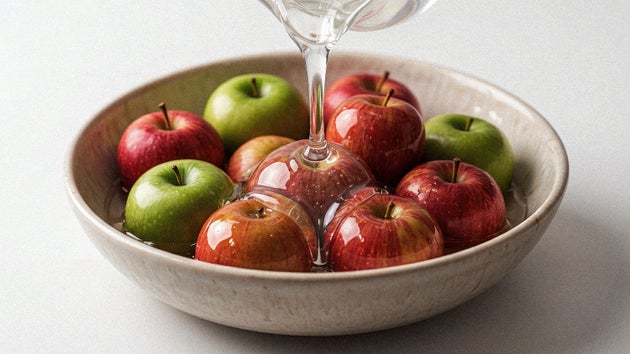
Illustration: HuffPost; Photo: Getty Images
Like this article? Keep independent journalism alive. Support HuffPost.
Although wax helps apples look shiny and more appealing, the primary reason apple producers coat apples in wax is to replace the natural wax that’s lost during production. A thin, food-grade wax coating helps the fruit retain moisture during storage and transport, Schwan explained.
Apple producers around the world, including in the European Union, Hong Kong, New Zealand and the United States, apply wax to apples. Doing so is “critical since apples are often stored for months under refrigerated conditions. Without the wax coating, apples would lose water more quickly, shrink, become soft and wrinkle, reducing quality,” Schwan explained. Without edible waxes, over a third of apples would spoil before reaching a retailer.
Advertisement
Must Read: You Actually SHOULDN’T Wash 1 Kind Of Lettuce, According To Food Safety Experts
Is the wax applied on apples safe to eat?
Here’s what we know: Fruit and vegetable producers have been applying wax on produce since 1924, more than 100 years ago. Today, all waxes used on apples in the U.S. are deemed food-grade, safe to eat and Food and Drug Administration-approved.
These waxes are “often derived from natural sources such as shellac or carnauba wax from palm leaves. Sometimes, apple producers mix the type of wax they use to achieve the right balance of shine, moisture barrier and texture,” Schwan explained. If you’re skeptical about eating ingredients with names like shellac or carnauba wax, you’re not alone. But a panel of scientists from the European Food Safety Authority found that “there is no concern for genotoxicity” for the use of carnauba wax as a food additive, such as in apple wax, and its use “would not be of safety concern.” Similarly, in 2025, an EU commission found that shellac “is not liable to have an effect on human health” when used as a coating for fruit.
These waxes have the designation of Generally Recognized as Safe (GRAS) by the FDA. Although some items on the GRAS list are banned in other countries, the ingredients used in apple wax are approved for use by various food safety bodies around the world, including the European Union, the Hong Kong Centre for Food Safety and the United Nations’ Food and Agricultural Organization and World Health Organization.
If you’re still feeling uneasy about eating apples coated with wax, it may be reassuring to know that only about one drop of wax per apple is typically used, explained Dr. Alex McDonald, a family medicine physician with Kaiser Permanente Southern California. However, he emphasized that eating large amounts of wax-coated apples doesn’t change how safe they are to eat. “There is no known dangerous amount of consumed food-grade wax on fruit. Eating one apple or 10 apples makes no meaningful difference in wax safety because the coating is such a tiny fraction of the fruit and isn’t toxic,” he explained.
Home: A Horrifying TikTok Reveals The Dangers Of Drinking From Glass Straws — If You Use Them, Read This
What happens to the wax you eat?
If you’re wondering what happens to the wax on apples after you eat them, the answer is simple. “The wax is not absorbed and passes through your digestive tract,” McDonald explained. Once that happens, it is excreted in your feces.
One more thing: The time it takes to remove wax from apples may be more harmful than anything if it prevents you from eating them. “Most Americans don’t get enough fruits and fiber in their diet and apples are a great way to get more fiber and nutrients to keep themselves healthy. After all, an apple a day keeps the doctor away,” McDonald said.
Related... -
'Spies Are For Pies:' Baking Tips That'll Drastically Improve Your Apple Pies
Are Apples Really THAT Good For You?
These Are The 10 Best Apple Varieties For Baking A Pie
Read the original on HuffPost
Source: “AOL Breaking”
