


Investors Just Got a Blunt Reality Check From Fed Chair Kevin Warsh. Here's What History Says Is Coming Next.
Investors Just Got a Blunt Reality Check From Fed Chair Kevin Warsh. Here's What History Says Is Coming Next.

Reuben Gregg Brewer, The Motley FoolTue, August 4, 2026 at 2:35 AM UTC
0
Key Points -
After the dot-com bubble, Federal Reserve Chairman Greenspan began providing more guidance to the market.
During the Great Recession, the Fed started giving even more explicit guidance.
Kevin Warsh's Fed is paring back the guidance, leaving investors to figure things out for themselves.
These 10 stocks could mint the next wave of millionaires ›
&&
Uncertainty is hard for investors to deal with. And uncertainty is also one of the key issues investors need to address. During recent periods of heightened economic uncertainty, however, the Federal Reserve attempted to soothe investor fears by providing more policy certainty. Kevin Warsh, the new head of the Federal Reserve, thinks things have gone too far. Here's what he's doing about it and what it could mean for Wall Street.
How did we get here?
Like so many things in life, the current approach taken by the Federal Reserve didn't emerge from a vacuum. In fact, what existed up until the most recent meetings was created with good intentions. During the dot-com bubble, Alan Greenspan's Fed began offering some guidance in its comments, so the bond and stock markets could be assured there was a backstop. It was an understandable move, given the crashing stock prices at the time.
Missed Nvidia in 2009? This Rare Signal Is Flashing Again.In 2009, a "Double Down" signal flashed for a little-known chipmaker called Nvidia. For the first time in years, that same "Total Conviction" signal is flashing for a company 1/100th the size of Nvidia. Continue »
&&
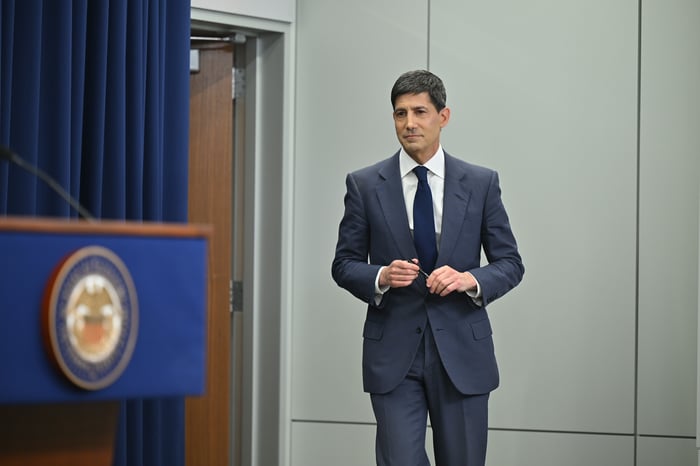
Image source: The U.S. Federal Reserve.
That guidance continued until the Great Recession, one of the worst recessions in U.S. and world history. There was a legitimate fear that the global economic order would collapse. In response, the Fed, under Ben Bernanke, began providing more explicit guidance. Again, it was an understandable decision, given the extreme circumstances. Stabilizing the bond market and U.S. economy were paramount, and easing investor concerns was a key part of the process.
However, the market quickly began to discuss what would eventually become known as "the Fed put" under Greenspan. Essentially, the Fed put is the believe that the Fed will step in to help the market if there's any material turbulence. Forward guidance made the Fed put look all the more real, even though there is never an explicit policy to back it. There is a moral hazard in the Fed put and the forward guidance that seems to support it, since some investors believe it gives them the leeway to invest more aggressively.
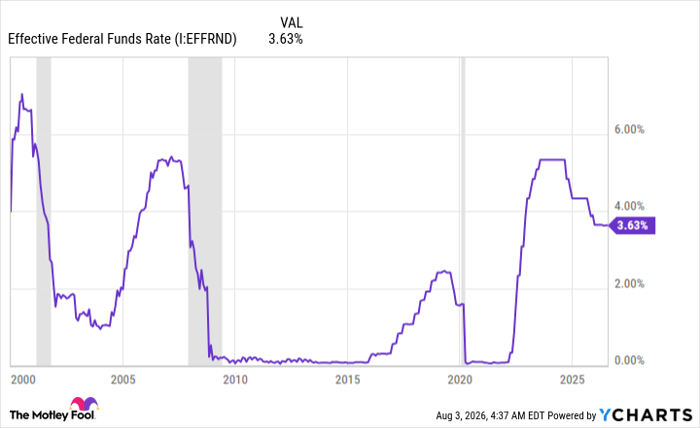
Effective Federal Funds Rate data by YCharts
Kevin Warsh changes things back to the way they used to be
New Fed chair Kevin Warsh has been pretty clear that he believes forward guidance needs to end. His goal is basically to force the market to figure things out on its own. Forward guidance is already gone, and there are even hints that the number of meetings the Fed holds could be trimmed.
Advertisement
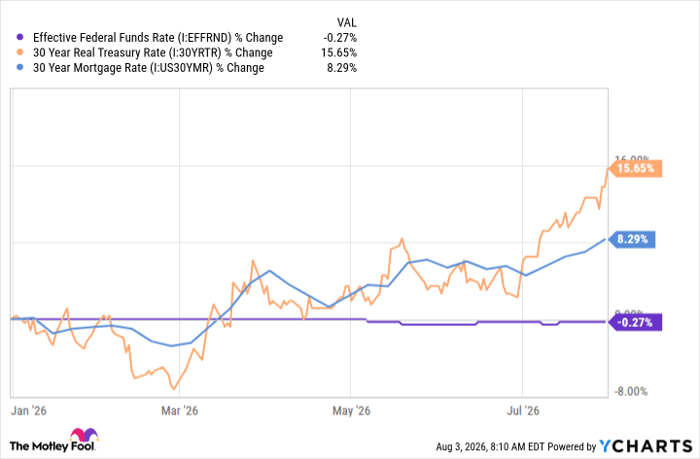
Effective Federal Funds Rate data by YCharts
After the most recent meeting, Warsh commented that, "Market participants are learning to play the ball, not the referee." That comment specifically discussed the rise in bond rates between the last two Fed meetings. Warsh made very clear that he believes this is a good outcome, with investor actions in the market perhaps even allowing the Fed to avoid making rate moves. Essentially, investors reacting to real-time market changes could, on their own, put guardrails in place. Without a Fed put and explicit guidance, that's the logical course of action.
Not knowing may be better for you
What investors can expect next, for better or worse, is more uncertainty. However, that's how the market has historically operated, even though it can increase short-term volatility. Essentially, every investor in the stock and bond market assesses the risks and rewards and places a bet on the future. At a group level, investors tend to be pretty good at figuring things out. That is, in fact, the whole logic behind prediction markets. It isn't a perfect system, and the Fed will be there to make adjustments if needed.
However, investors may find that taking the lead is preferable to the government leading the way and effectively offering a backstop for risk-taking. When investors believe there are minimal consequences for overly aggressive investment choices, they increase risk-taking, ultimately creating more risk. So, look for increased uncertainty, but perhaps also a healthier stock and bond market.
Where to invest $1,000 right now
When our analyst team has a stock tip, it can pay to listen. After all, Stock Advisor’s total average return is 906%* — a market-crushing outperformance compared to 208% for the S&P 500.
They just revealed what they believe are the 10 best stocks for investors to buy right now, available when you joinStock Advisor.
See the stocks »
*Stock Advisor returns as of August 3, 2026.
&&
The Motley Fool has a disclosure policy.
Source: “AOL Money”
